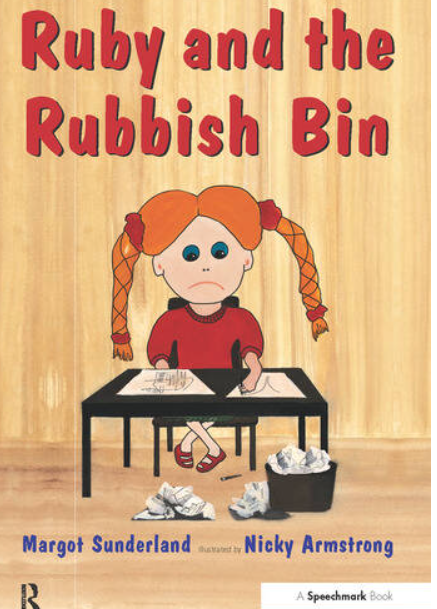
Ruby and the Rubbish Bin
By Margot Sunderland, Speechmark, 2003
This book starts powerfully by explaining that Ruby feels like something you find in a bin. We see her being called rubbish by bullies and having ice cream wrappers thrown at her. Next we see her being bullied by a teacher who criticises her for not being neat enough. Immediately we see the impact on Ruby who describes everything she does as rubbish. We learn that sometimes she feels like getting into a rubbish bin and never coming out . The text is hard hitting but honest when Ruby is described as feeling so rubbish that she wanted to sleep and never wake up again.
Fortunately help is at hand. A new dinner lady called Dot has moved into Ruby’s Street. Dot is kind to Ruby and explains to her that when some people feel inadequate, they try to make themselves feel better by becoming bullies. At school the next day when the bullies and her teacher are criticising her, Ruby tells them she is not rubbish and that they are putting her down only to make themselves feel better.
Ruby and Dot the dinner lady become good friends. It is so much fun that Ruby feels they are flying. She still feels like rubbish from time to time but Dot helps her sort out her feelings. She makes new friends. By the end, look out for how Ruby now responds when someone calls her ‘lovely.’
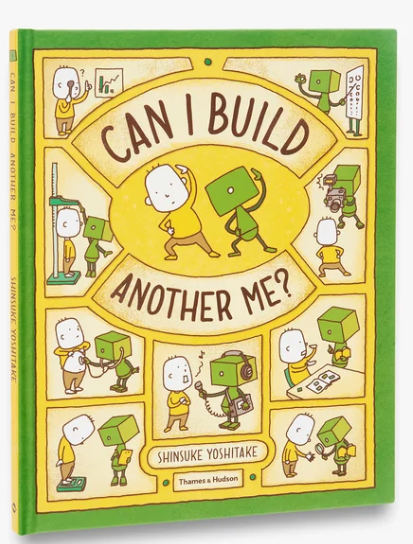
Can I build another me
By Shinsuke Yoshitake, Thames & Hudson, 2016
This is a graphic novel, not a picture book. The story picks apart what makes a person who they are. It starts with the physical body with the boy saying he often gets holes in his socks, he’s left-handed and has freckles on his nose. He lists his likes and dislikes, as well as what he can and can’t do. He can wink but what he cannot do is something to which many children will relate.
We see him with smaller versions of himself inside him like Russian dolls. They are his younger selves. Even now the boy realises that he is ever changing. Sometimes he is in different moods or bored but all the versions of him are still himself. He reflects on others ideas of him. His teacher might say he messes around in class and his friend might say he’s good at swimming. He has some thoughts he doesn’t share which are his own private world. This message is what his grandma tells him. It is whether you like yourself that counts.
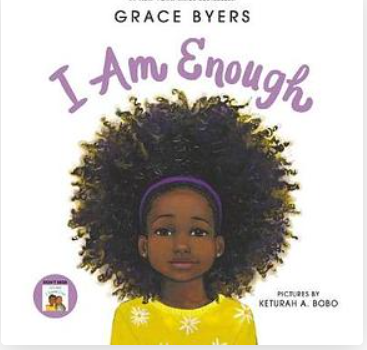
I am enough
By Grace Byers, Balzer and Bray at Harper Collins, 2018
This is a gloriously inspiring book with wonderful illustrations. It begins with a picture of a child in front of a magnificent sun. The message is that everyone is here to shine, fly and thrive. Not only that but that everyone is enough as they are. I found the book moving in its simplicity.
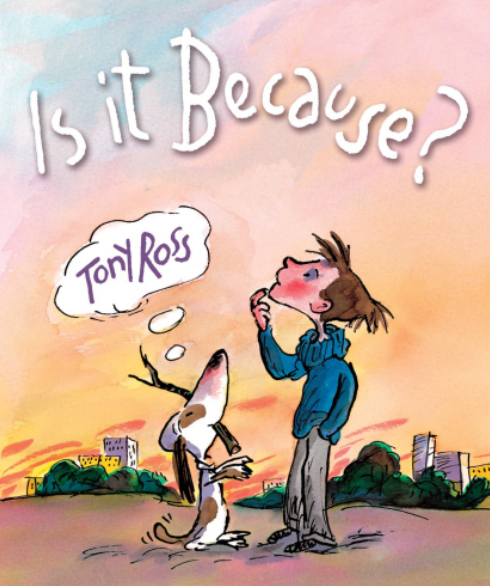
Is it because
By Tony Ross, Andersen Press Ltd, 2006
While bullying is not a pleasant topic, the illustrations add beautifully to the humour that runs through this story. The text is in the form of a comic, rhyming poem. A boy wonders aloud why another boy bullies him. I found the ending insightful and, in my view, very often true. I won’t spoil it, but he gains an eventual understanding of why the bully is the way he is. At the same time he recognises his own value.
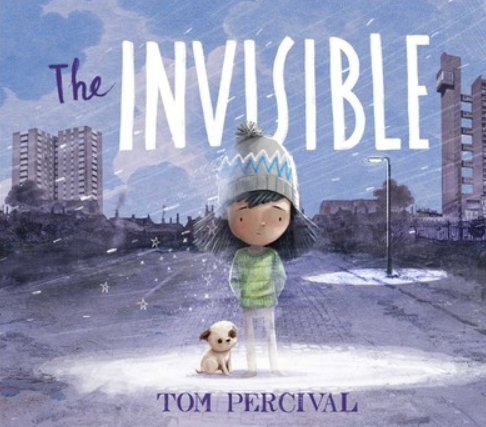
Invisible
By Tom Percival, Simon and Schuster, 2021
This book is about a child who feels invisible due to poverty. Her family has to move to a poorer part of town and the implication is that to rich people she is nothing. However, the girl meets other invisible (excluded) people. They connect together and make a difference to their community. The illustrations are wonderful, especially how the ‘invisible’ people are drawn without colour, like ghosts.