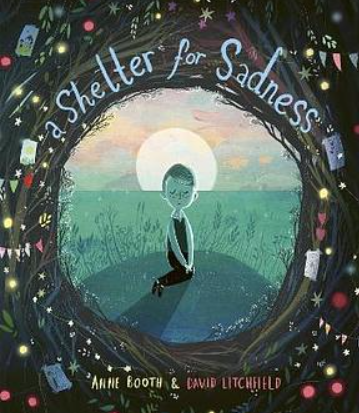
Shelter for Sadness
By Annie Booth and David Litchfield, Templar books 2022
In this book sadness is carefully represented as a furry blob with an impression of arms and a face. He comes to live with a child.
Instead of trying to force the sadness away, the child builds it a shelter. He looks after the sadness, visiting it every hour if needed. Sometimes they talk and hug. Sometimes they gently sit there and say nothing.
When the sadness is ready, the story explains that it can emerge and the two of them will discover the beauty of the world together.
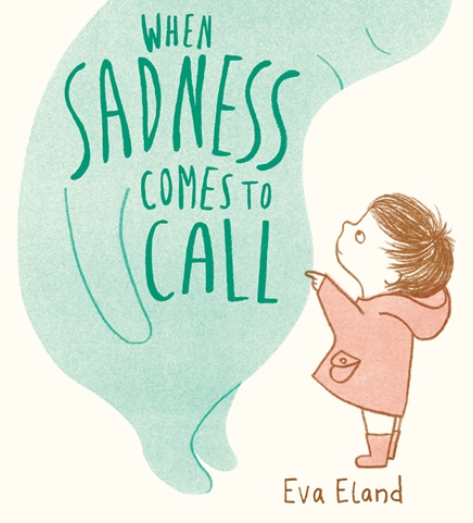
When Sadness comes to Call
By Eva Eland Andersen Press, 2019
This is a beautiful book showing children how to cope with sadness. It represents sadness as a pale blue blob, with a personality and face. The idea here is that the child needs to befriend his feelings. Children will enjoy how the main character and his sadness find they can make friends together and even drink hot chocolate. All the sadness wants is to know that it’s welcome and to find comfort, knowing it is not alone. Eventually, an illustration shows the sadness snuggled up, asleep with the sad child. Once it finds care, it is ready to move on.
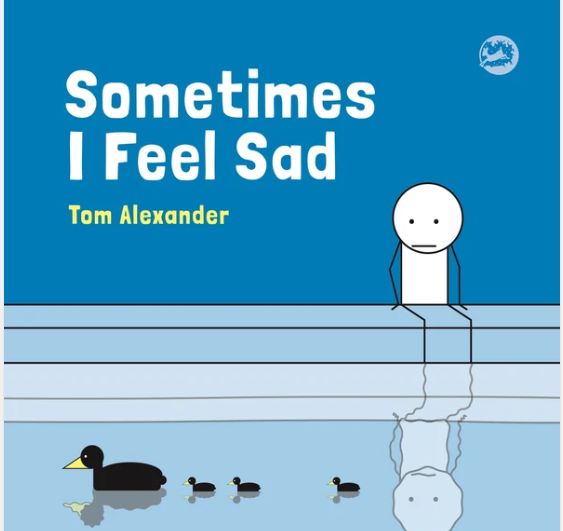
Sometimes I feel Sad
By Tom Alexander, Jessica Kingsley Publishers, 2018
In this book, the illustrations are all stick people, and the text is both simple and honest. For example, it comments that sometimes being around other people helps and sometimes it doesn't.
Sometimes doing something fun cheers up the main character. Sometimes it just makes him feel sad. The main point of the book is that it can be hard to let other people know when you are feeling sad. The main character worries about what they will think of him or that it will make them sad too. The book urges the reader to tell others how they are feeling but adds that some will not pay attention, believe them or just tell them to cheer up. It says those things don't help. It shows that in the end that what makes him feel better is when someone says it's okay to feel sad sometimes. That means he no longer feels alone.
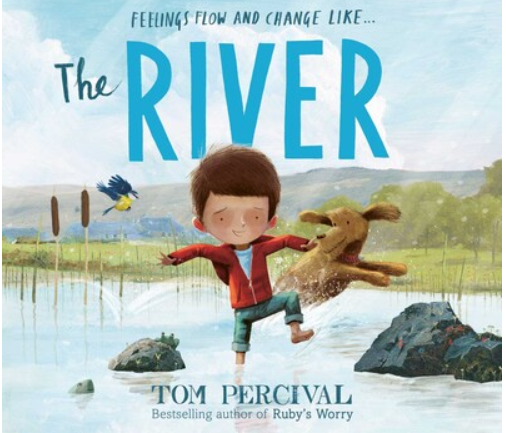
The River
By Tom Percival , Simon & Schuster 2022
The author writes about being depressed as a child. The implication is that it is after the dog has died. His parents try to cheer him up but nothing really works until he rescues and releases an injured bird. All this time the river has been frozen even though it is no longer winter. When he experiences joy in the bird and releases it, the river unfreezes.
My perspective is that this is also a book about the seasons of life and aging. The character comes to realise over the years, that he has different moods like the river; happy, sad and everything in between. He concludes that, like the river, he is always changing. By the last page he has grown from a little boy to an adult and his parents have aged
The Wonder
By Tom Percival, Simon and Schuster 2026
Daniel is in a terrible mood. He is drawn in grey. However, the beautiful things he doesn’t see are in colour such as a flower growing in the pavement. When he gets splashed by traffic, it confirms his view that it is going to be a terrible day. Then he hears a sweet sound. There is an illustration of soft rainbow light reaching him. Sunlight shines down on some musicians. Daniel smiles because he senses something wonderful just for him. His outlook changes.
Now in life he looks for flashes of joy and wonder. Some of his joy moments are big and some small. Some last a while and some are fleeting which only makes them more special. Some are shared with other people and some he experiences alone. Now he smiles often because he knows he lives in a world where magic and wonder exist. Now he is able to share that with other people.

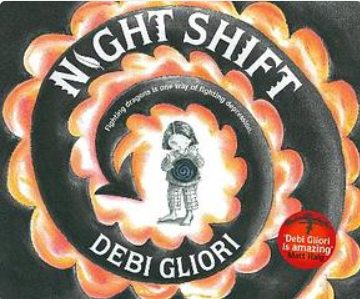
Nightshift: Fighting dragons is one way of fighting depression
By Debi Gliori, Hot key books 2017
I would not categorise this as a children’s book, but the main character is a child. Depression is represented by dragons. The book’s purpose is to educate others about depression. I have included it as it may help supporting adults understand how a depressed child may be feeling. It is ultimately a story of hope.
The author begins by commenting that she is not sure how it began and perhaps it drifted in like a fog. It shows a child sleeping in bed and the fog drifting across her face. A few pages later we see an unpleasant dragon standing on her and the text explains that the fog rolled in every night and also during the day. We see an ominously dark dragon shadow outside her bedroom door. The girl’s stomach is drawn as a twisting black swirl, like a galaxy and she explains she felt hollowed out. She looks in the mirror, unsure of who she is anymore and a dragon is looking back at her.
Next, the book describes how she tries to cope. There is a list of daft advice from others. We see her trying to light a candle, but she ends up covered in broken matches. However, she develops ‘night skills’ which she calls the ability to survive inside her own darkness. A ‘night skill’ is illustrated by a dragon blasting her with fire. Next, the child is on a tightrope blindfolded with a dragon’s claws round her head. She tries to run. The dragon is standing behind her telling her that it’s pointless and that she’s too weak to even try. She thinks it is right. However, the girl drags herself to the top of a sand dune. There she finds something beautiful and something shifts.
On the last page, there is a message from the author. She says she is not special but she will arm wrestle dragons for eternity if she can help anyone going through a similar struggle.
The Red Tree
By Shaun Tan. Lothian children's books 2001
This book has fascinating images, and each is worth exploring. At the very start, dead leaves convey a sad mood so vividly. Later, the picture of the girl in the bottle will speak to many readers. The way hope returns is dramatic and beautiful. The ending took me by surprise in a wonderful way. I would love to hear what others think, of this and other illustrations, as this project grows. Some images hold a lot inside them. Do check it out!